A decade in: what Storage King taught us about doing offshore properly
Someone asked me recently which client relationships have taught us the most, and Storage King kept coming up. Not because it was our biggest engagement or our most complicated one. Because it's our longest, and longevity has a way of exposing whether something actually works or just looks good in a pitch.
We've been embedded in Storage King's finance organisation since 2014. That's before werk:out had its name. Before I'd fully worked out what this business was going to become. A relationship that predates your own rebrand tells you something, if you're willing to listen to it.
Storage King thought they needed more hands. What they actually needed was a little outside-the-box thinking.
That line sounds like a pitch deck one-liner. It's actually just what happened.
What we found when we looked closer
Storage King came to us needing help with a large volume of supplier bills. The kind of ask that usually means "we need more people processing invoices." So we went in expecting to scope out extra capacity.
What we actually found surprised us. Those bills, in real volume, across a business with sites all over Australia and New Zealand, were being processed manually into a desktop-based accounting system. Not cloud. Desktop. Invoice by invoice, by hand.
Storage King builds and manages storage facilities for a living. Nobody there needed a lesson in boxes. But somewhere along the way, their invoices had ended up in one anyway, figuratively speaking, sitting in a system that couldn't scale with the rest of the business.
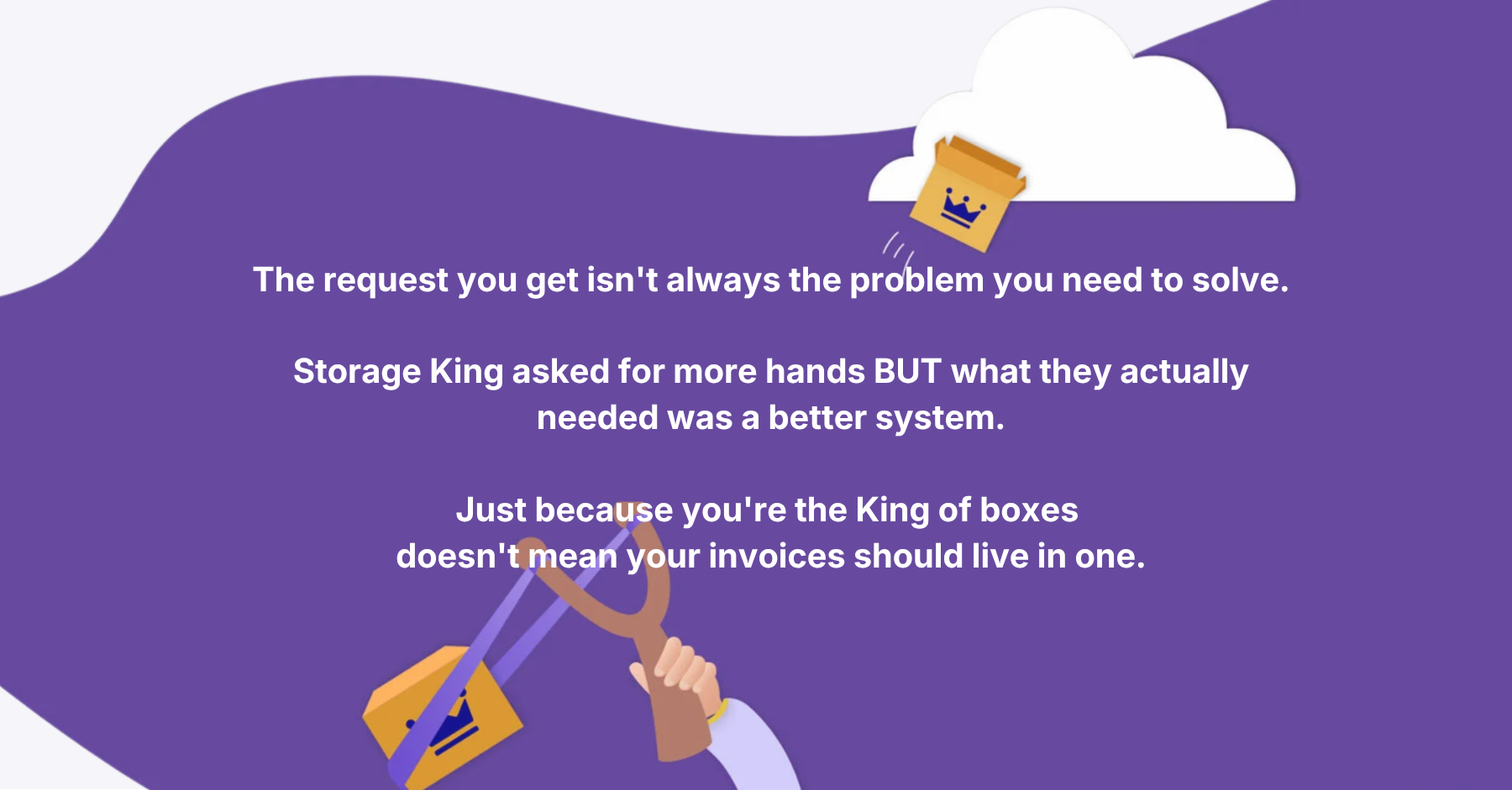
Just because you're the King of boxes doesn't mean you should be keeping invoices in them.
Why that mattered more than it looked
For most businesses, a clunky manual process is an efficiency problem. Annoying, costly, fixable when there's time. For a listed company, it's something closer to a risk problem.
It isn't enough to just get the invoices paid. Governance has to hold up. Financial control has to be demonstrable, not just assumed. Whatever function handles that volume of work has to align with what the CFO and senior leadership actually need to see, not just move paper faster. A manual, desktop-bound process sitting underneath all of that isn't just slow. It's a control gap waiting to be noticed at the worst possible time.
And there was one more thing Storage King was clear about from the start, which I think gets underestimated by a lot of outsourcing providers. They didn't want an anonymous offshore operation somewhere in the org chart that nobody could quite picture. They wanted a team. People they could name.
I understand why that mattered to them. I spent years inside large finance organisations before werk:out existed, watching how easily an outsourced function can turn into a black box. Work goes in, output comes back, and nobody in the building can tell you who actually did it or whether they'll still be there next quarter. That's not a partnership. That's a mailbox with a service fee attached.
So the brief was never going to be solved by throwing more hands at manual data entry, ours or anyone else's. More hands would have just meant more people doing the wrong process, slightly faster.
From boxes to the cloud
After identifying the actual problem, we designed a strategy to migrate Storage King onto cloud-based accounting and introduce accounts automation software, streamlining bill processing across every Storage King site in Australia and New Zealand at once, not one location at a time.
We catapulted Storage King's invoices out of a desktop filing system and into the cloud. But that migration wasn't the finish line. It was the foundation for something that had to keep running long after the project plan ended.
Built to last: a team, not a project
To support the new process, we built a dedicated Service Delivery Team that worked as part of Storage King's finance operation specifically for bill processing. Accountant-level people and AP specialists, embedded, accountable, and around long enough to actually know the business.
That team didn't stay confined to the job it started with. As Storage King identified new needs elsewhere in the business, the team expanded into other functions, and it's kept expanding since. What's actually run through all of it, whether it's bill processing or whatever's next, is the same underlying process: analysis, modelling, integration, automation. Look at how the work actually happens, find where it's straining, and build the system and the team to match, in that order.
Ten years on, in their own words
Two people who'd know put it better than I could.
Reiner Low, Storage King CFO: "werk:out has been deeply embedded in Storage King's Finance Organisation since 2014, helping us modernise systems and build a seamlessly integrated offshore team."
Michael Tate, Founder and former Storage King CEO : "werk:out has supported Storage King using their proactive approach to understand our operational gaps. They integrated new technologies to assist us to be 'better'. They continue to be an integral part of our drive to improve our operations."
Notice neither of them talks about invoice processing speed. They're talking about a team that keeps finding the next gap before it becomes a problem.
What this actually teaches, beyond Storage King
A few things I keep coming back to from this relationship.
The request you get isn't always the problem you need to solve. Storage King asked for more processing capacity. What actually moved the needle was migrating the system underneath it and automating what used to be manual. Take the time to look underneath the ask before you staff up to meet it.
Governance and oversight aren't the opposite of offshoring. They're what makes it work at any scale that matters. A business worried about control isn't wrong to worry. They're asking the right question, and the answer is structure, not a sales pitch that tells them not to worry about it.
Integration beats isolation every time. The moment an offshore team is treated as a separate unit rather than part of the function, you've built two teams that will always have friction between them.
People who are building a career do better work than people who are filling a shift. That's true everywhere, but it's especially visible over ten years. Storage King's Service Delivery Team has kept its institutional knowledge because the people holding it have had a reason to stay, and a reason to keep looking for the next thing to fix.
The part that isn't really about accounts payable
Here's what I'd say to a business owner reading this who doesn't run a listed company and doesn't have a Procure-to-Pay function to speak of.
The specific problem doesn't matter as much as the shape of it. If there's a workflow in your business that's grown past what your current setup can handle cleanly, invoices, payroll, reporting, receivables, some process that used to be manageable and now eats a disproportionate amount of someone's week, that's the same category of problem Storage King had. Different scale, same shape. And the fix probably isn't "add more people to do it the same way."
We've built a cloud migration, automation strategy, and an embedded Service Delivery Team for a listed company. We've also built a Virtual CFO and finance team setup for a cybersecurity start-up with no finance infrastructure at all, and dedicated bookkeeping support for boutique accounting firms too stretched to take on more clients. Different businesses, same underlying question: is there a piece of your operation that would run better with a different system, the right people embedded in it, and a reason for them to stay?
If the answer is yes, that's a conversation worth having, whether you're a listed company or a business that's never had an offshore conversation before.
Ten years is not the normal outcome in this industry. A lot of offshoring arrangements churn through providers every eighteen months because the relationship was built around price rather than fit. Storage King's story isn't remarkable because the accounts payable function works well. Plenty of functions work well for a year or two. It's remarkable because it's still working, and still expanding, with largely the same philosophy behind it, a decade later. That's the actual product. Everything else is delivery.