Is a Virtual CFO right for you?
What a CFO is actually for
I spent thirty-five years in finance before werk:out existed. Ernst & Young, then Serco in the UK and the Middle East, then Citrix where I opened their first APAC office as Regional CFO. Different countries, different industries, wildly different businesses.
The job was never really about the numbers.
The numbers were the raw material. The job was turning them into decisions. Should we open that office. Can we survive this quarter if the big client leaves. Is this growth real or are we just moving cash around faster. Do we hire now or wait six months.
A bookkeeper records what happened. An accountant tells you what it means for tax and compliance. A CFO tells you what to do next.
Most Australian business owners I meet have the first two covered. They have a bookkeeper. They have an accountant who does the annual return. What they do not have is anyone whose job is to look forward.
If nobody in your business is paid to look forward, you are the CFO. Whether you signed up for it or not.

Here's me and Sapher CEO, Joseph Villalobos visiting India for a series of meeting with business partners.
The signs, and how to read them honestly
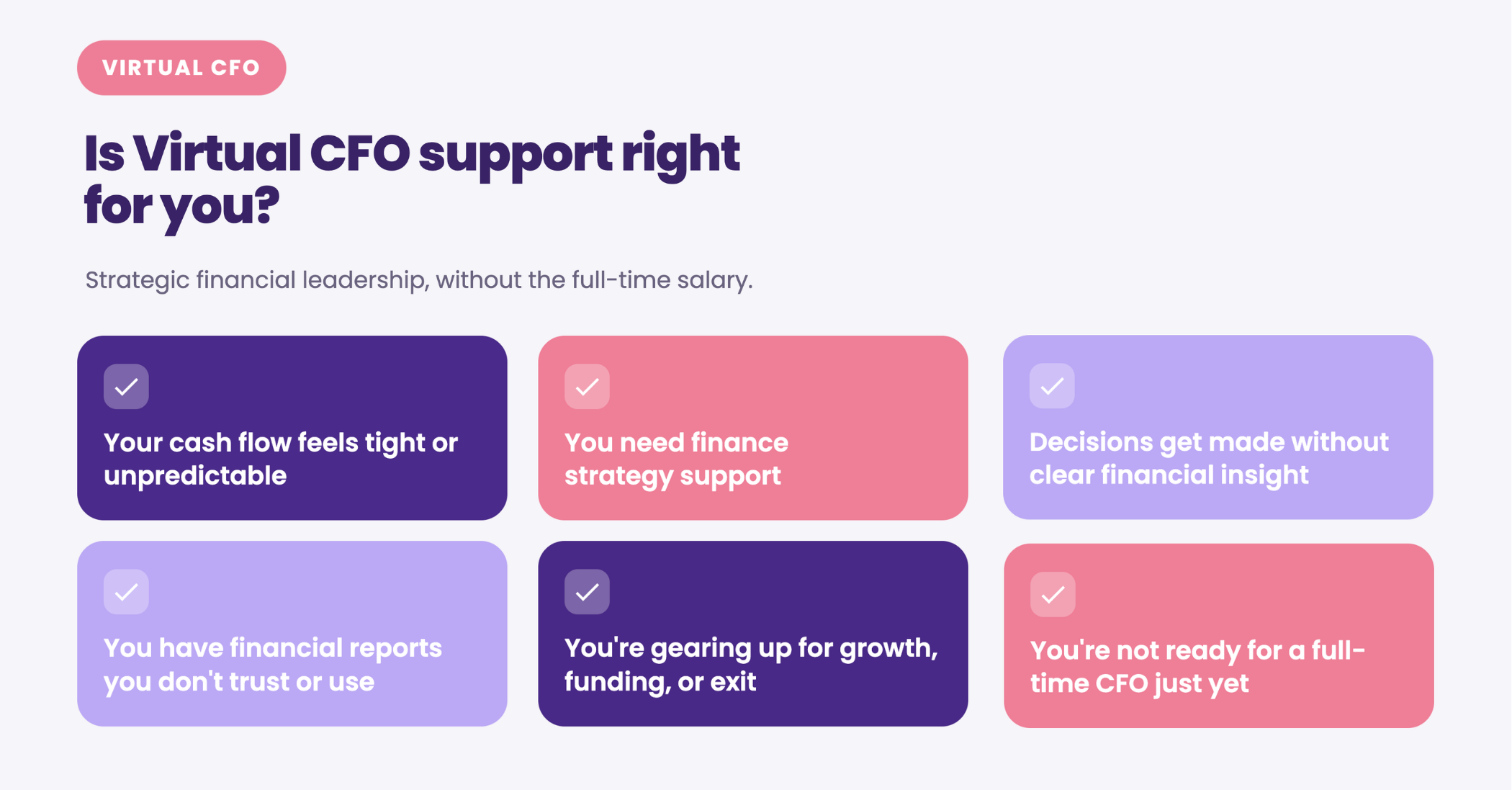
There is a list on our website of the signs you might need a Virtual CFO. Cash flow feels tight or unpredictable. You have reports you do not trust. Decisions get made without clear financial insight. You are gearing up for growth, funding, or an exit.
Those are accurate. But lists like that have a problem. Every business owner reads them and thinks yes, all of it, always. Running a business feels like that most weeks.
So here is a sharper test. Three questions.
One. When did you last make a real decision using a number?
Not a gut call you justified afterwards with a number. An actual decision where you looked at the data first, and the data changed your mind. If you cannot remember one in the last six months, that is the sign.
Two. Are you profitable but always short on cash?
This one catches a lot of people, and it is the most common reason a business gets into trouble while looking healthy on paper. Profit and cash are not the same thing, and the gap between them is where businesses quietly die. If your P&L looks good but you are watching the bank balance nervously before every payroll, something structural is going on that a monthly report will not surface on its own.
Three. How many hours a week do you personally spend on finance?
If it is more than ten, you are already employing a CFO. You are just paying for it with your own time, which is the most expensive currency you have, and you are almost certainly doing the job worse than someone who has done it for thirty years. That is not a criticism. It is not your job.
If two or three of those land, the conversation is worth having.
When the honest answer is no
I want to be clear about this part, because I think most people writing about Virtual CFOs skip it.
If your revenue is still small and your business model is simple, you probably do not need CFO-level thinking yet. You need clean books, a good accountant, and a bit more time. Bringing in strategic finance before you have anything to be strategic about is a waste of your money and my time, and I will say so on the call.
If your books are a mess, that is also not a CFO problem yet. A CFO working off bad data will give you confident advice built on nothing. Fix the foundation first. That is usually a Virtual Finance Team conversation, not a CFO one.
And if what you actually want is someone to blame when the numbers are bad, no arrangement will fix that. I say it lightly, but I have seen it.
The businesses where a Virtual CFO earns its keep are the ones where complexity has outrun the founder's bandwidth. Growing fast. Multiple revenue streams. A funding round coming. An acquisition on the table. A board asking questions the founder cannot answer quickly. That is the moment.
A Virtual CFO is not a step up from your accountant. It is a different job entirely.
The cost question, honestly
Hiring a CFO in Australia is expensive. By the time you account for salary, superannuation, payroll tax, leave, and recruitment, a full-time CFO is a serious six-figure commitment, and for most businesses under a certain size it is simply not the right shape of spend.
The Virtual CFO model exists because that gap is real. You get the thinking without the headcount. You scale the engagement up when you are raising or acquiring, and down when things are steady.
I am not going to publish a price list here, because the honest answer is that it depends on what you actually need, and any number I quote without knowing your business is a guess dressed up as advice. What I will say is that the comparison is not CFO versus no CFO. It is CFO-level thinking versus the cost of the decisions you are currently making without it. That second number is invisible, which is exactly why it does not get counted.
What it looks like at werk:out
Three ways in, depending on where you are.
CFO only. You have a finance function that works. You need someone at the strategic level. We come in above what you already have.
CFO plus a Virtual Finance Team. You need both the doing and the thinking. Bookkeeping, payroll, payables, receivables, and monthly reporting handled by a dedicated team in the Philippines, with CFO oversight sitting across it. This is the setup we built for a cybersecurity start-up that was scaling quickly with no finance infrastructure underneath it.
Finance team only. You have strategic finance covered. You need the engine room.
The part that matters more than the structure is who is actually on the other end of it. Dudy and I manage our clients personally. You are not handed to an account manager who reads your file before the call. Twelve years in, that is still how we do it, and it is the main reason we have stayed boutique rather than trying to become a machine.

Here's me and Dudy at the opening of a client's aesthetic clinic.
So, is it right for you?
If you are guessing at your numbers, if you are profitable but cash-poor, if finance is eating your week, then the answer is probably YES and the only question left is timing.
If you are early, simple, and your books are clean, the answer is not yet. Come back when it gets complicated. It will.
Your growth. Your decisions. Your business. We just make sure the engine is always running.
Whether you have been burnt by big outsourcing firms before, or you are exploring offshoring for the first time, werk:out is built for exactly where you are right now.
Visit us at: www.werkout.com.au
Get in touch: www.werkout.com.au/contact
We're excited to werk some magic with you!